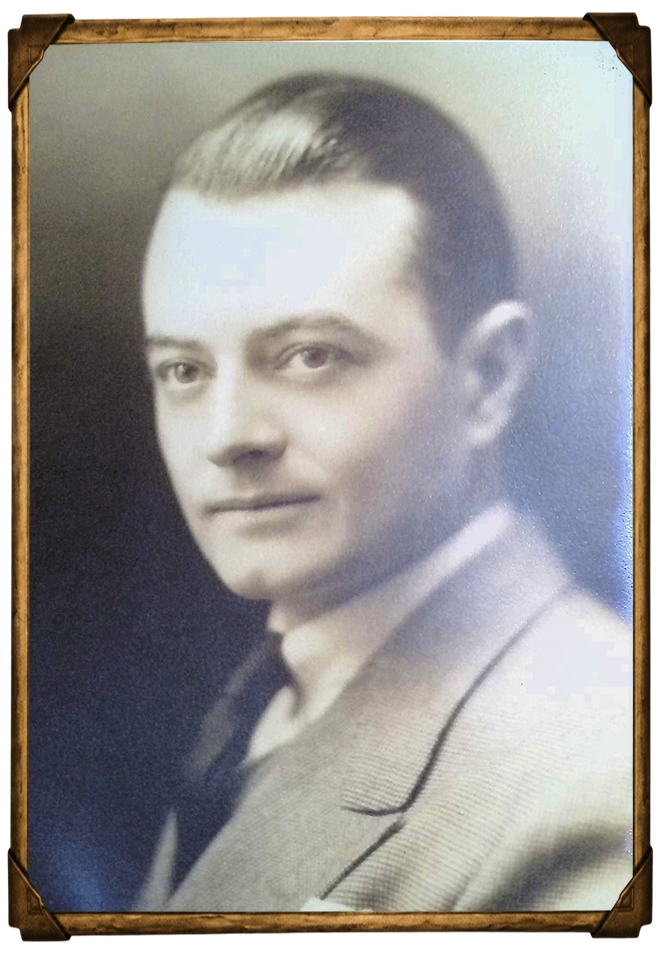
Chief of the Visa Section at the American Consulate in Marseille, Myles Standish issued thousands of visas and travel documents to refugees stripped of their citizenship by the Nazi regime, in direct defiance of his own government's orders. This is the life behind the stamp.
This is exactly where your "A Life, Not Just a Legend" text belongs. Here it is dropped into the three-paragraph slot, with one addition to fill the space next to the portrait:
Long before Marseille, Myles was a restless kid from New York who legally took the name of his supposed Mayflower ancestor, drove a secondhand Studebaker across the country at twenty, survived twenty-seven flat tires in Idaho, and came home the week the stock market crashed. He talked his way into the Foreign Service without an Ivy League pedigree, learning Spanish from a one-man schoolhouse in a Cuban village and working his way up from clerk to Vice Consul in six months flat.
He fell in love twice, married two remarkable women from opposite sides of the Atlantic, and raised children who called him "Pooh" and never once heard him raise his voice about the danger he'd lived through. By the time he reached Marseille in 1940, he had already watched a country fall to war, and he understood, in a way most of Washington did not, exactly what was at stake for the people standing in his consulate line.
He wasn't famous. He wasn't a saint. He was vain sometimes, stubborn often, and certain of his own judgment nearly always. But when the moment demanded a decision between what was legal and what was right, he made it, over and over, long after it stopped being safe to do so. Rescue in the Holocaust tells the whole man: the diplomat, the father, the flawed and funny and fiercely principled human being behind one of the least-known rescue stories of the Second World War.
"He was a wonderful gentleman and a model citizen who simply did the noble thing.", Deborah Smith, lifelong family friend.
Discover The Untold Legacy of Myles Standish
He never sought recognition, and history nearly forgot him along with it. Now, for the first time, his full story- the rescues, the risk, and the man behind them- is told in his own family's words.
"I picked this up expecting a history lesson and got something closer to a gut-punch. By chapter three I'd forgotten I was reading nonfiction; I just wanted to know what happened to the people in that line."
Mary Paul
owner
"What got me wasn't the heroism, it was the cost. This isn't a book about a man who did the right thing easily. It's about what it took out of him to do it at all."
Sarah Phill
owner
"I've read a lot of WWII history, and I'd never heard Myles Standish's name before this book. That alone tells you something. It shouldn't have taken this long for his story to surface."